The information on this website is general in nature and does not take into account your objectives, financial situation, or needs. Consider seeking personal advice from a licensed adviser before acting on any information.
Motorcycle loan repayments are shaped by the amount borrowed, interest rate, loan term, fees, repayment frequency and any balloon or residual payment. Understanding how these factors work together can help Australian riders compare finance options and estimate affordability before applying.
Motorcycle loan repayments are not based on the bike price alone. In Australia, your repayments generally reflect the amount you borrow, the interest rate, loan term, fees, repayment frequency and any balloon or residual payment included in the loan structure.
Understanding these moving parts can help you use a motorbike loan calculator more effectively, compare repayment estimates and ask clearer questions before applying for finance. This article provides general information only and does not consider your personal objectives, financial situation or needs.
The basic repayment calculation
A motorcycle loan repayment is usually calculated by spreading the financed amount, interest and some fees over an agreed loan term. The lender sets the repayment schedule, which may be weekly, fortnightly or monthly depending on the loan agreement.
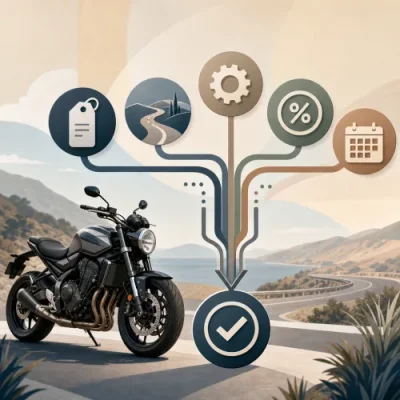
In simple terms, repayments are influenced by:
- Loan amount: the amount financed after any deposit, trade-in or upfront payment.
- Interest rate: the cost of borrowing, expressed as a rate and applied under the lender's calculation method.
- Loan term: the length of time over which the loan is repaid.
- Fees and charges: establishment fees, account fees, early repayment fees or other costs that may apply.
- Repayment frequency: how often you make repayments.
- Balloon or residual payment: a larger final amount due at the end of the loan, if included.
Different lenders may structure and calculate repayments differently, so a repayment estimate should be treated as a guide rather than a final offer.
How the loan amount affects motorcycle loan repayments
The loan amount is one of the biggest drivers of motorcycle finance repayments. The more you borrow, the more principal needs to be repaid and the more interest may accrue over the life of the loan.
Your loan amount may include more than the motorcycle's advertised price. Depending on the purchase and finance arrangement, it may also include:
- dealer delivery or on-road costs;
- registration and transfer costs;
- optional accessories or riding gear financed with the bike;
- insurance or warranty products, if financed and suitable for the arrangement;
- lender or broker fees that are added to the loan rather than paid upfront.
A deposit or trade-in can reduce the amount financed. For example, if two riders buy the same motorcycle but one contributes a larger deposit, the rider borrowing less will generally have lower repayments, all else being equal.
Before applying, it can be useful to separate the bike's purchase price from the total amount you may need to finance. A lower advertised price does not always mean a lower total loan cost if extra charges are added.
How interest rates change the total cost
The interest rate determines how much you pay for borrowing the money. A higher rate generally increases repayments and total interest paid, while a lower rate generally reduces them, assuming the same loan amount and term.
Motorcycle loan interest rates may vary based on factors such as:
- your credit history and repayment profile;
- your income, employment type and overall financial position;
- whether the loan is secured against the motorcycle or unsecured;
- the age, value and type of motorcycle;
- the lender's credit policy and risk assessment;
- the loan term and amount borrowed.
Rates can be fixed or variable, depending on the product. A fixed rate may provide more predictable repayments during the fixed period. A variable rate may change if the lender changes the rate, which can affect repayments or loan cost.
If you want to understand rate influences in more detail, see Getting the Best Loan Rates for Your Motorbike Purchase. Remember that advertised rates may not be the rate you are offered, and final pricing depends on individual circumstances and lender criteria.
How the loan term affects repayments and total interest
The loan term is the period over which you agree to repay the motorcycle loan. A longer term usually lowers each individual repayment because the debt is spread over more payments. However, it may also increase the total interest paid over the life of the loan.
A shorter term usually means higher repayments, but it may reduce total interest if the rate and other factors are the same.
| Loan term choice | Typical repayment effect | Potential total cost effect |
|---|
| Shorter term | Higher regular repayments | May reduce total interest paid |
| Longer term | Lower regular repayments | May increase total interest paid |
The right term is not just about finding the lowest repayment. It should also be considered alongside cash flow, total loan cost, bike usage, expected ownership period and whether the motorcycle may depreciate faster than the loan balance reduces.
Fees can change the true cost of a motorcycle loan
Fees are easy to overlook because they may seem small compared with the bike price. However, they can still affect the total amount payable and, in some cases, the repayment amount.
Common fee types to check may include:
- Establishment or application fees: charged when the loan is set up.
- Monthly or account-keeping fees: charged during the loan term.
- Broker or origination fees: charged for arranging finance, where applicable.
- Early repayment or break costs: charged if you repay early or change the loan before the agreed term ends.
- Late payment fees: charged if repayments are missed or delayed.
Some fees may be paid upfront. Others may be added to the loan amount, which means you may pay interest on them. When comparing motorcycle loan costs in Australia, look beyond the repayment amount and ask for a clear breakdown of interest, fees and the total amount repayable.
For more on clauses that can affect flexibility, review The Fine Print: What to Look for in Flexible Motorcycle Loan Agreements.
How repayment frequency affects cash flow
Motorcycle loans may allow weekly, fortnightly or monthly repayments, depending on the lender and loan structure. The repayment frequency changes how often money leaves your account and can affect how easily the loan fits your pay cycle.
A weekly repayment may look smaller than a monthly repayment, but it is not automatically cheaper. To compare repayment options fairly, check the total amount paid over a year and over the full loan term.
For example, a monthly repayment schedule has 12 payments per year, while a fortnightly schedule usually has 26 payments per year. A weekly schedule usually has 52 payments per year. The dollar amount of each repayment must be compared in that context.
When using a bike loan repayment calculator, make sure the repayment frequency matches how you intend to pay. Otherwise, you may underestimate or overestimate the impact on your regular budget.
Balloon and residual payments
Some motorcycle finance arrangements may include a balloon or residual payment. This is a larger amount payable at the end of the loan term. It can reduce regular repayments during the loan, but it does not remove the cost. The final amount still needs to be paid, refinanced or otherwise dealt with under the loan agreement.
A balloon payment can make regular repayments appear more affordable, but it may increase risk if you are not prepared for the final payment. It can also affect your options if the motorcycle's value is lower than expected when the loan ends.
Before agreeing to a balloon structure, consider asking:
- How much will the final payment be?
- Is interest charged on the balloon amount during the loan?
- What happens if I want to sell or trade the motorcycle before the end of the term?
- Can the balloon be refinanced, and under what conditions?
- What is the total amount payable across the full contract?
A lower regular repayment is not always the lower-cost option once the final payment is included.
Secured and unsecured loans can calculate differently
Motorcycle finance may be secured or unsecured. With a secured loan, the motorcycle is generally used as security for the loan. With an unsecured loan, the lender does not take security over the motorcycle in the same way, although the borrower is still legally required to repay the debt.
This distinction can influence the rate, loan amount, term, lender criteria and fees. Secured motorcycle loans may have different pricing because the lender has an asset as security. Unsecured loans may offer different flexibility, but pricing and eligibility can vary.
For a broader comparison, see Understanding Secured vs Unsecured Loans for Your Dream Motorcycle.
Using a motorbike loan calculator wisely
A motorbike loan calculator can help you test different repayment scenarios before you apply. It is most useful when you use realistic inputs and compare one variable at a time.
For example, you might estimate repayments by changing:
- the loan amount after adding on-road costs and subtracting your deposit;
- the interest rate to see how sensitive repayments are to pricing;
- the loan term to compare repayment size against total interest;
- the repayment frequency to check cash-flow fit;
- any balloon or residual amount, if relevant;
- fees, if the calculator allows them to be included.
Calculator outputs are estimates only. They may not include every fee or condition, and they are not an approval or an offer of credit. The repayment quoted by a lender may differ after assessment of your application, credit profile, motorcycle details and supporting documents.
Repayment amount versus affordability
A repayment estimate is only one part of affordability. Motorcycle ownership can also involve registration, insurance, maintenance, tyres, servicing, protective gear, fuel, parking and unexpected repairs.
Before deciding how much to borrow, consider whether the repayment remains manageable if your expenses rise or your income changes. A loan that fits your budget on paper may still become difficult if it leaves no room for ordinary running costs.
Useful affordability questions include:
- Can I make the repayment comfortably on my regular income?
- Have I allowed for insurance, servicing and registration?
- Would I still manage the loan if interest rates, living costs or work hours changed?
- Am I relying on overtime, bonuses or irregular income to afford the loan?
- Will the motorcycle still suit my needs for the length of the loan term?
What to check before applying
Before submitting a motorcycle loan application or eligibility assessment, it can help to have a clear view of the repayment inputs. You may not know the final rate or approval outcome yet, but you can still prepare.
Consider checking:
- the total purchase price, including on-road costs and accessories;
- your preferred deposit or trade-in contribution;
- the loan term that suits your budget and ownership plans;
- whether you prefer fixed or variable repayments, if options are available;
- whether a balloon payment is being proposed;
- the fees payable upfront and over the loan term;
- the total amount repayable, not just the regular repayment;
- conditions for early repayment, refinancing or selling the bike.
If you are ready to explore your options, Bike Loan Finance Online provides a general eligibility assessment pathway that may help you understand potential finance options based on your circumstances. Any finance outcome will depend on lender criteria, responsible lending assessment and the details of your application.
Key takeaway
Motorcycle loan repayments are calculated from several connected factors: how much you borrow, the interest rate, loan term, fees, repayment frequency and any balloon payment. Changing one factor can affect both your regular repayment and the total cost of the loan.
Before focusing on the lowest-looking repayment, compare the total amount payable and check whether the loan structure suits your budget, motorcycle plans and repayment capacity. A repayment estimate is a useful starting point, but the final terms depend on your individual circumstances and the lender's assessment.
Published: Wednesday, 26th Aug 2026
Author: Paige Estritori




I nearly got caught by a balloon payment on motorbike finance; the weekly repayment looked fine until the final bill was explained.